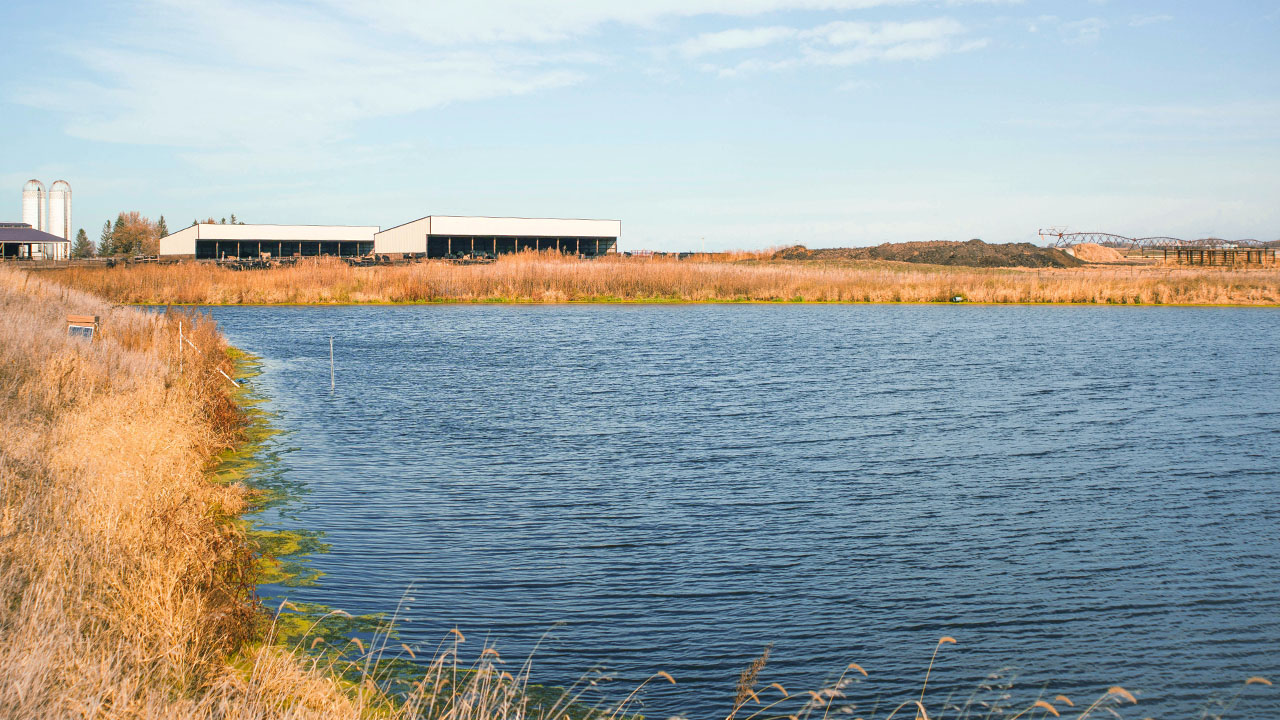
(Photo: Iowa Soybean Association / Joseph Hopper)
<!–
–>
February 5, 2024
<!–
–>
By Dr. Chris Hay, Affiliate Assistant Professor, Department of Agricultural and Biosystems Engineering, Iowa State University
Drainage water recycling is a practice that combines crop production benefits for the farmer and water quality benefits downstream. A drainage water recycling system captures subsurface (tile) drainage and potentially water from surface runoff or other sources, and stores it in a reservoir for supplemental irrigation. The Research Center for Farming Innovation (RCFI) has been collaborating with researchers from Iowa State University to evaluate this practice in Iowa.
Three sites are being monitored for the impacts of drainage water recycling on crop yield and water quality. Each site is uniquely designed.
The first site, near Story City was installed in 2015. It captures subsurface drainage from about 20 acres that is supplemented by water pumped from a nearby creek.
The reservoir for the second site, near Lake City, was constructed in a waterway fed by the outflow from a large drainage district main and has an outlet structure for when inflows exceed the reservoir storage capacity.
The third site, near Dayton, uses a sump to pump water from an adjacent county drainage main into an excavated reservoir.
Crop yield
At the Story City site, 60 acres are irrigated and another 100 acres are not irrigated. However, the acres have the same soil type and management, serving as a good control for comparing the irrigated and rainfed yields.
Corn yield data has been available since the system began operation in 2016. Yields were greater in the irrigated portion of the field in every year except for 2018, when there was ample rain and no irrigation was used, and in 2020, when the derecho damaged the center pivot.
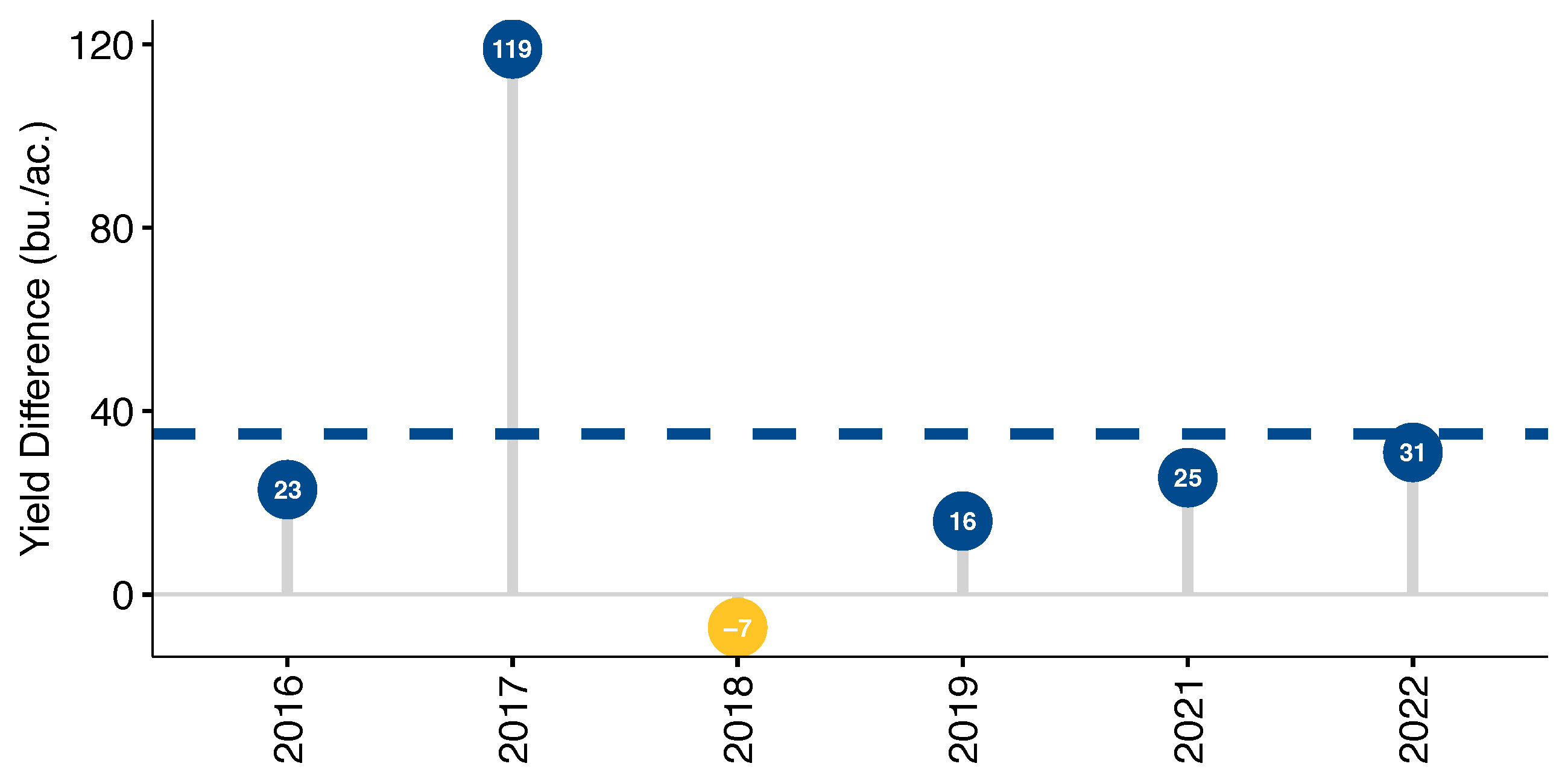
Yield increases ranged from -7 bushels per acre in 2018, when there was no irrigation, to 119 bushels per acre in 2017. The yield increases are largely explained by differences in precipitation, with 2017 precipitation 32% less than the 30-year average whereas precipitation in 2018 was well above the 30-year average. The overall average corn yield increase from the supplemental irrigation was 35 bushels per acre. In addition to greater overall yields, there was less year-to-year variability in yield in the irrigated portion of the field. Yield monitor data show that yields were more consistent in the irrigated portion within individual years.
Water quality
With the two new sites in Lake City and Dayton, there are now four site years of water quality monitoring to evaluate the water quality benefits of drainage water recycling.
To understand the water balance of each system, inflows and outflows were measured. Those inflows and outflows and the water stored in the reservoir were also sampled for nitrogen and phosphorus concentrations.
Other water losses from evaporation and seepage and nutrient losses in the seepage were estimated. The nutrient load reductions from the drainage water recycling systems could be calculated with the flow amounts and nutrient concentrations.
In all four site years, nitrogen loads were substantially reduced. This was from a combination of concentration reductions from storage within the reservoirs and nitrogen recycled back into the field through supplemental irrigation.
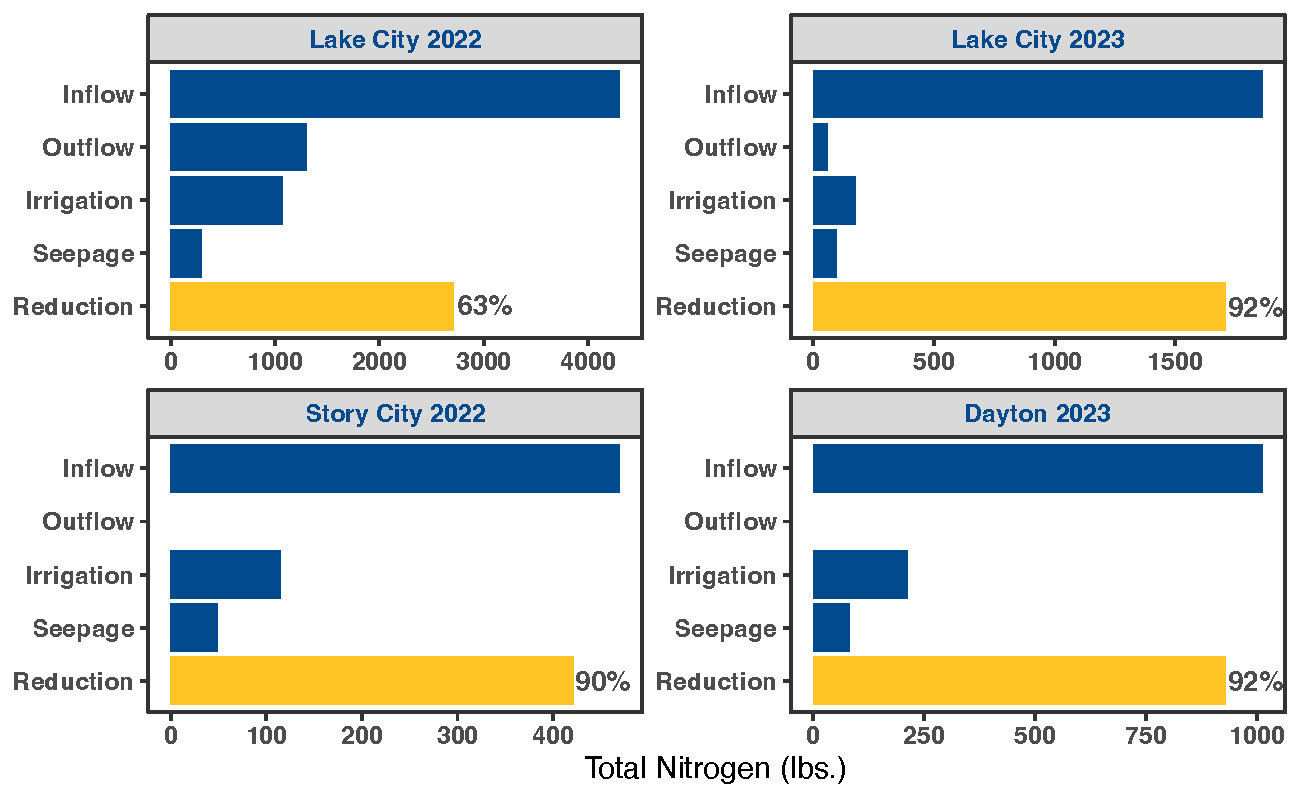
Nitrogen in the irrigation water was assumed to be available for plant uptake or would otherwise be reduced, and nitrogen load reductions were calculated as nitrogen in the inflows minus nitrogen in any outflows and seepage.
On a percentage basis, nitrogen load reductions ranged from 63% to 92%. Nitrogen load reductions at Story City and Dayton were 90% and 92% with no outflows other than seepage.
At Lake City, nitrogen load reductions varied by year. With greater inflows in 2022, more water and nitrogen were released back to the stream in reservoir outflows, so nitrogen load reductions were less. In the drier conditions of 2023, reservoir inflows were less, outflows were minimal, and the nitrogen load reduction was greater.
Looking at load reductions in terms of the total amount of nitrogen removed shows the differences in the system designs.
Dayton is entirely filled from pumped inflows, and inflows to Story City are largely pumped from the stream. Therefore, the water pumped in is only enough to fill the reservoir, so the inflow amounts of nitrogen were less than at Lake City.
At Lake City, all the discharge from the upstream drainage district main passes through the Lake City reservoir. So, even though some of the water and nitrogen exceeded the reservoir storage capacity and was released back to the stream, there was still an opportunity for nitrogen reduction from treatment as it passed through the reservoir.
Although 2022 at Lake City had the smallest percentage reduction, it had the greatest overall load reduction of more than 2,700 lbs. of nitrogen.
Conclusions
Drainage water recycling has shown strong potential as a practice that boosts crop production and improves water quality. Research continues on these sites and will hopefully expand to more sites. Additional site years will allow us to better understand how drainage water recycling performs at different sites and under different weather conditions which will then help us better understand the economics of these systems.